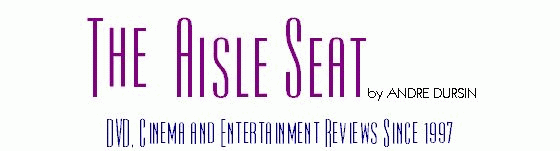
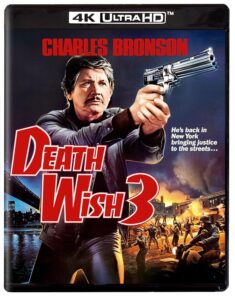
Charles Bronson scored a huge hit in the 1974 Dino DeLaurentiis-produced adaptation of Brian Garfield’s novel “Death Wish.” It took several years to firm up a follow-up, but once Cannon Group moguls Menahem Golan and Yoram Globus got their hands on the property, it was no shock that the sequel machine would soon be cranked up to maximum with Bronson returning to his original role of Paul Kersey, who here takes his street clean-up back to his native New York City in DEATH WISH 3 (91 mins., 1985, R; Kino Lorber), not just Bronson’s best Cannon film but also one of the most deliriously entertaining action flicks of the decade.
 With the series stretched out over some 20 years, it’s interesting to chart its transition, where the “realistic” first film, released in ‘74, was followed belatedly by a somber 1982 sequel that was marred by a graphic rape sequence. Director Michael Winner returned for the third installment, along with Bronson in what would be the last of their half-dozen collaborations together, but this time, augmented with a bigger budget and a slightly different agenda.
With Sylvester Stallone having taken “Rambo” to box-office heights and other stars like Arnold Schwarzenegger and Chuck Norris packing theaters, Golan-Globus decided to make Kersey more of a one-man wrecking crew this time around, which enables this bigger-is-better follow-up to offer a higher body count and nearly comic-book styled action as Kersey is lured back into town at the behest of an old war buddy who wants protection for him and his neighbors (including Martin Balsam) from the local gangs.
The “Death Wish” formula had already been well established by now but with Cannon bringing the production over to London, the action manages to be wilder and far less disciplined this time out under Winner, who infuses the material with a degree of hysteria and even a few one-liners he scripted alongside Don Jakoby (the movie lists the pseudonym “Michael Edmonds” for its final screenplay credit). The supporting cast offers Ed Lauter, Deborah Raffin, Gavan O’Herilhy (“Superman III”), future Star Trek TNG star Marina Sirtis, and Alex “Bill & Ted” Winter among its familiar faces, while like the second picture, it’s scored in groovy rock fashion by rocker Jimmy Page (arranged and conducted here by “Time Bandits”’ Mike Moran).
With its lean running time and broadly played gunfights and urban skirmishes, “Death Wish 3” is pretty much the apex of Bronson’s ‘80s output as well as the high point for Cannon action movies of that era as well. With nowhere to head but near self-parody, Michael Winner goes for broke here with a tone that’s sillier and far less believable than its predecessors, but in so doing, creates a more entertaining film that showed the veteran star could hold his own with the likes of his younger contemporaries – at least for one final go-round.
A sequel that’s become an understandable cult favorite over time, “Death Wish 3” debuts a new 4K scan (1.85) of the 35mm OCN on UHD from Kino Lorber. The Dolby Vision HDR transfer offers gains across the board from its previous releases (even a 2K Scorpion remaster from 2020) in terms of grain, clarity and color. The mono soundtrack is just fine while a new 5.1 track has been added alongside an enjoyably chatty commentary by Steve Mitchell and Nathaniel Thompson. A brief interview with actor Kirk “The Giggler” Taylor has been carried over from the Scorpion release plus Paul Talbot’s sage commentary, the original trailer (which credits Jakoby), an alternate ending, and a similarly remastered Blu-Ray that works off this 4K scan. Highly recommended!
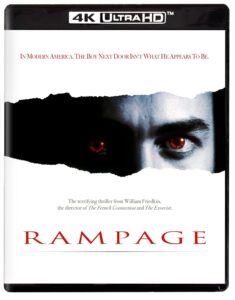 RAMPAGE 4K UHD (95/91 mins., 1987, R; Kino Lorber): One of director William Friedkin’s least-known films stars Alex McArthur as a serial killer eventually caught after senselessly murdering a number of victims; the local prosecutor, played by Michael Biehn, subsequently attempts to make sense of his actions while contemplating whether or not he should embrace the death penalty, in a Friedkin-scripted picture scored by Ennio Morricone.
Shot on a modest budget, “Rampage” was produced by Dino DeLaurentiis’ DEG studio but infamously never received a release once the studio went belly up. The movie did manage to generate a Japanese laserdisc as well as a Virgin soundtrack album for Morricone’s efforts, but largely went unseen until Miramax grabbed it in the early ‘90s, albeit mandating some changes to Friedkin’s original version. The director, in the process, used the opportunity to re-craft the film from a more ambiguous piece into something much more straightforwardly advocating for the death penalty.
Kino Lorber’s 4K UHD of “Rampage” offers both cuts of the movie in Dolby Vision HDR (1.85, 5.1/2.0 DTS MA) along with a corresponding Blu-Ray. The shortcomings inherent with the movie largely remain in either version, though – namely, that the picture’s rather weak script results in a mere surface-level treatment of its inherently disturbing subject matter, and is so superficially developed that the alteration of just a few scenes here and there (as can be evidenced by these two cuts of the film) can change the entire meaning of the work. The picture just doesn’t connect to a satisfying degree in either version, with the second half of the movie, confined mostly to a courtroom and dealing with Biehn’s shifting perspective (sort of) on MacArthur’s culpability, coming off as stilted and unconvincing, while the opening seems designed for shock value and little more.
“Rampage” is ultimately one of Friedkin’s lesser works but fans will still want to check out Kino Lorber’s UHD as it provides viewers the opportunity to properly assess its two versions. The transfers of the movie are both excellent but especially the original cut of the movie which bears the DEG credits and lists a 1987 copyright. The 1992 “Miramax cut” is, on balance, not quite as strong as Friedkin’s earlier version, and the transfer looks a little more processed by comparison. The 2.0 stereo track is a bit amped-up with hiss while the 5.1 mix is mostly confined to the front channels by comparison; sadly, working with a “traditional” composer for one of the few times in his career does not result in an especially effective collaboration between Friedkin and Morricone.
Extras include a new interview with Alex McArthur, who notes he later turned down the Buffalo Bill role in “Silence of the Lambs,” plus a featurette with genre writer Harold Schechter and commentaries on both versions with Howard S. Berger and Nathaniel Thompson.
 DUST DEVIL 4K UHD/Blu-Ray (108/88 mins., 1992, R; Kino Lorber): Filmmaker Richard Stanley’s career is an odd one, with the director first catapulting to fame with the British sci-fi thriller “Hardware” before running into studio interference for the first time with its follow-up, “Dust Devil.” The good news is, while Stanley’s original script comes off as undernourished dramatically, his visuals – and the film’s vivid African locales – come across beautifully in a new 4K scan of the OCN in Kino Lorber’s UHD. The desolate, gorgeous, evocative landscapes are superbly captured and rendered here in Dolby Vision HDR, providing the viewer with heavy atmosphere that the movie’s thin story – involving a mysterious Dust Devil (Robert Burke), traveling the land sucking up souls, and who next focuses on a woman (Chelsea Field) in a dysfunctional marriage – doesn’t match in terms of effectiveness.
Still an interesting view for genre devotees, Kino’s UHD/Blu-Ray sports a commentary by Stanley on his original, 108-minute Director’s Cut, included here in 4K (1.85) alongside a bastardized Miramax re-edit (88 minutes). Other extras include a featurette/interview with Simon Boswell carried over from a 2006 release plus storyboards, polaroids, the trailer, a 16mm trailer, and the movie’s remaster on Blu-Ray.
THE CAT AND THE CANARY 4K UHD/Blu-Ray (79 mins., 1927; Kino Lorber): John Willard’s stage play “The Cat and the Canary” was written in 1922 and set the blueprint for many a mystery to follow, wherein a group of squabbling, mostly dishonest family members gathers for the reading of a will, only to find out the fortune they covet necessitates they spend the night in the old dark mansion of their (not so) dearly departed…with a crazed killer at large as well.
Black comedy and suspense mingle in Willard’s play, which had become a big hit when it was first officially brought to the screen in a 1927 Universal silent film starring Laura La Plante. Later remade several times including as a Bob Hope vehicle in the late ‘30s, the original silent version has its place in cinema history and now has been restored by Photoplay in a 4K restoration (1.33) from original nitrate prints and included in Kino Lorber’s new UHD/Blu-Ray combo pack. The Photoplay restoration is color tinted and includes a score by Neil Brand; Kino’s release also includes insightful commentaries by David Del Valle and Randy Haberkamp on one track, and Anthony Slide on another. The slipcover-encased release also features Paul Leni’s 1925 short “Rebus-Film No. 1” in standard definition.
 RADIOLAND MURDERS Blu-Ray (108 mins., 1994, PG; Universal): This overly-manic comedy from executive producer George Lucas gestated for decades before finally being produced in 1994 under the direction of British comedian Mel Smith. It’s hard to tell if “Radioland Murders” was actually conceived to be a successful feature – as it was once intended by original writers Gloria Katz and Willard Huyck as a madcap “American Graffiti” prequel in the ‘70s before languishing in development hell – or just a testing ground for Lucas’ desire to shoot a movie with all-digital backdrops.
Indeed, this farce boasts ample production personnel (cinematographer David Tattersall, production designer Gavin Bocquet among them) who would soon work on Lucas’ “Star Wars” prequels, but while the movie’s story is more frantic than funny, it’s not the total loss you might have thought: this tale of a murder during a live radio broadcast in 1948 Chicago does boast a terrific ensemble cast (Mary Stuart Masterson, Ned Beatty, Jeffrey Tambor, Christopher Lloyd, Michael McKean, Stephen Tobolowsky, Brian Benben, plus cameos by George Burns and Rosemary Clooney) and a wonderfully vintage soundtrack by Joel McNeely, sporting ample amounts of nostalgic ‘40s standards.
Kino Lorber’s “Radioland Murders” Blu-Ray hails from a new 2K scan (2.35) of the 35mm interpositive with 5.1 and 2.0 DTS MA sound that’s heavily “centered” throughout. I didn’t see Universal’s previous barebones Blu-Ray but this transfer is satisfyingly rendered while the movie’s sound design is one of its strongest elements and Kino has included extras including the trailer and a new talk with Brian Benben, commentary by Bryan Reesman and Max Evry, and the trailer. Benben’s interview is quite interesting as he details shooting in North Carolina and Lucas being on the set quite a bit, along with working with a fantastic cast.
 From The Dan Curtis Files
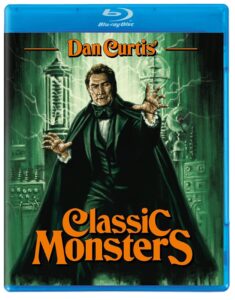
DAN CURTIS’ CLASSIC MONSTERS Blu-Ray (343 mins., 1968-74; Kino Lorber): Fresh off the success of TV soap sensation “Dark Shadows,” producer-creator Dan Curtis remained in the genre for a trio of new adaptations of well-worn movie monsters, the likes of which have been newly collected on Blu-Ray by Kino Lorber.
Jack Palance played the title role(s) in THE STRANGE CASE OF DR. JEKYLL AND MR. HYDE (1968) with Curtis’ production having been shot in the UK with Charles Jarrott helming Ian McLellan Hunter’s script. Palance is suitably menacing with Denholm Elliott providing strong support in this initial (videotaped) effort, while Robert Foxworth essays the good doctor FRANKENSTEIN (1973) in a Curtis production scripted by Sam Hall and directed by Glenn Jordan. Bo Svenson co-stars as the Monster with Susan Strasberg in a very slow-going affair hampered, like its predecessor, by the limitations of its videotape source, which only allows for so much resolution (1.33) even with HD upscaling as seen here.
Shot on a much bigger budget was their follow-up, BRAM STOKER’S DRACULA (1974), Curtis and Richard Matheson’s take on the oft-told novel with Jack Palance as the Count. In fact, several key elements of Matheson’s script (most especially the Vlad the Impaler connection) were carried over into Francis Ford Coppola’s 1992 movie of the same name. This European-lensed effort is a bit tedious at times but was, at least, shot on film by Oswald Morris and has far superior production values to the earlier Curtis productions, remastered here in a 1.85 widescreen aspect ratio (this was apparently released as a theatrical feature overseas).
Loads of extras in this Kino Lorber double-disc Blu-Ray set include intros from Curtis expert Jeff Thompson; commentaries from Mark Dawidziak (Dracula), Rodney F. Hill (Frankenstein), Robert Foxworth and John Karlen (Frankenstein), and Stephen R. Bissette (Jekyll & Hyde); archival interviews with Jack Palance, Dan Curtis and make-up mastermind Dick Smith; “Dracula” alternate footage and scenes; and broadcast promos.
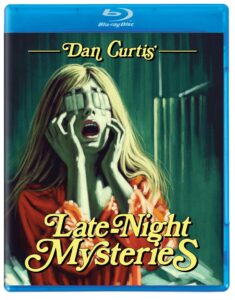
 DAN CURTIS’ LATE-NIGHT MYSTERIES Blu-Ray (265 mins., 1973; Kino Lorber): Among Curtis’ more obscure ‘70s TV productions were a series of movies shot for ABC’s “Wide World Mystery,” stand-alone outings shot on video tape that have been seldom seen since their original broadcasts. This month, in conjunction with MPI, Kino Lorber has remastered four of those thrillers for this two-disc Blu-Ray release: “Shadow of Fear” featuring Claude Akins and a young Tom Selleck; “The Invasion of Carol Enders” with Meredith Baxter (Birney); George Maharis and Eileen Brennan in “Come Die With Me”; and “Nightmare at 43 Hillcrest,” a tale of terrifying police corruption and mistaken identity with “Special Guest Star” Mariette Hartley. All four have been remastered from standard-def tape to HD while retaining their original 1.33 aspect ratios; extras include a number of commentaries (by the likes of Amanda Reyes among others) and introductions again on all four films by Curtis expert Jeff Thompson.
A few years later, Curtis helmed DEAD OF NIGHT (76 mins., 1976), an anthology of Richard Matheson stories produced on a similar line to their earlier collaboration on “Trilogy of Terror.” Here, Ed Begley, Jr. finds an antique car that brings him back in time in “Second Chance,” an adaptation of a Jack Finney story that’s the best of the batch; Anjanette Comer and Patrick Macnee in “No Such Thing as a Vampire”; and Joan Hackett in in the unsettling “Bobby.” Tim Lucas provides a commentary here while extras include the busted 1969 Curtis TV pilot “A Darkness At Blaisedon” with Kerwin Matthews, an introduction by Curtis historian Jeff Thompson, a featurette on “Robert Cobert’s Music Score Highlights,” deleted/extended scenes, and a 1.33 transfer.
ILSA: SHE WOLF OF THE SS 4K UHD/Blu-Ray (96 mins., 1974, R; Kino Lorber): Gene Siskel called it “degenerate,” leading the charge of critics who felt this Canadian sexploitation – or Nazisploitation – production was an embarrassment if not outright public affront. Whatever you call it, though, “Ilsa: She Wolf of the SS” became a box-office hit, graphically illustrating the pain and torture inflicted at a German concentration camp by a commandant (Dyanne Thorne) specializing in sadism. Don Edmonds’ independent film was shot quick and cheap on “Hogan’s Heroes” sets, and now comes to 4K UHD (1.66) for the first time with Dolby Vision HDR courtesy Kino Lorner and Lionsgate. The Kino Cult special edition features a finely hued transfer along with two commentaries: one with Thorne, Edmonds and producer David F. Friedman, the other with Kat Ellinger and Evgueni Mlodik. There’s also an interview with Edmonds, the trailer and a stills gallery.
Version 1.0.0
New on 4K UHD
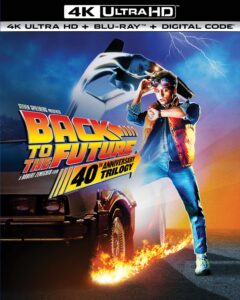
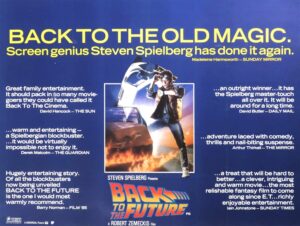
We’ve had 25th and 30th Anniversary Editions on Blu-Ray of “Back to the Future,” a 35th Anniversary “Ultimate Trilogy” box-set on Blu and 4K UHD, and now Universal is back with a BACK TO THE FUTURE: 40TH ANNIVERSARY TRILOGY edition, offering both UHD and Blu-Ray discs and a brand new set of special features. This eight-disc box-set boasts the same 4K transfers with Dolby Vision enhancement and Dolby Atmos audio mixes as the previous UHD, while incorporating all the extras from previous releases and adding a fresh bonus disc of assorted documentary featurettes.
The package includes, of course, 1985’s highest-grossing film, “Back to the Future,” along with its two sequels, shot back-to-back and released in Thanksgiving 1989 and May 1990, respectively.
Anyone who grew up in the ’80s undoubtedly saw the original Robert Zemeckis-directed, Steven Spielberg-produced classic more than a few times, and the good news is that the picture remains a joyful blast of entertainment, with wonderful performances, smart writing, and infectious energy. The sequels, while not on the pedestal of the original, remain highly worthwhile for separate reasons: 1989’s “Back to the Future Part II” offered a delirious, dizzying time-travel adventure with a brilliant and underrated final third that put an interesting spin on the events of its predecessor. However, for those who thought Part II lacked heart and romance, “Back to the Future Part III” reprieved the endearing character interplay of the original and brought the series to a fitting close.
Personally, I have a lot of wonderful memories of seeing the BTTF Trilogy while I was growing up. The original opened in 1985, right before I started 5th grade. Back then, Michael J. Fox was a known commodity due to his work on the hit NBC series “Family Ties,” and “Back to the Future” looked like a cute time travel picture geared specifically towards kids, with the “Steven Spielberg Presents” brand attached for good measure.
However, when I saw the movie for the first time that summer, it was clear even to a 10-year-old that the movie’s appeal extended far beyond the barriers of youth movie-goers. Adults loved the picture’s multi-generational story, which managed to encompass comedy, time travel, ’50s nostalgia, and themes of relating to one’s parents that are timeless — regardless of how antiquated some of the ’80s jokes are (including the hilarious reference to Tab, which was dated even when the movie was first released!).
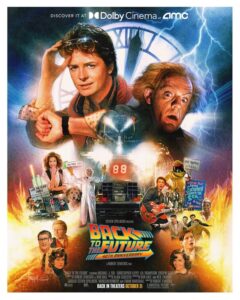 For a lot of reasons, BACK TO THE FUTURE (116 mins., 1985, PG) is one of my favorite films. Fox plays Marty McFly, a typical ’80s teen with typical ’80s parents whose relationship with crazy inventor Doc Brown (Christopher Lloyd) results in Marty traveling back to 1955. There, he inadvertently alters the course of his own history by disrupting the moment when his father (Crispin Glover) and mother (Lea Thompson) met and fell in love. What’s worse, mommy now has a crush on him (!), forcing Marty to find a younger Doc and try to set things right before his existence is wiped away.
There’s just an optimistic and charming element inherent in Robert Zemeckis and Bob Gale’s BTTF screenplay that few films in the sci-fi/fantasy genre possess. Fox’s Marty and Christopher Lloyd’s Doc Brown are two highly likeable protagonists, and equally noteworthy is the supporting work of Thompson and Glover as Marty’s parents, along with Thomas Wilson’s bully Biff Tannen. While the picture’s portrayal of both the ’50s and the ’80s are highly idealized, they still provide an interesting contrast to Fox’s quest to reunite his flawed parents and keep his existence together after causing a rift in the space-time continuum.
In nearly every facet, BTTF works splendidly — here we have one of Alan Silvestri’s best scores, Dean Cundey’s warm cinematography, a couple of bouncy Huey Lewis & The News hits, and a story that continues to entertain even some 40 years after its original release.
Four years later, Zemeckis and Gale, along with most of the original cast and crew, returned to the series for a pair of sequels shot simultaneously.
Although a box-office hit, BACK TO THE FUTURE PART II (109 mins., 1989, PG) is a movie that received a negative (and mostly unwarranted) backlash from critics and audiences shortly after its release. Most of the complaints came from viewers who didn’t care for the picture’s frantic, non-stop action, open-ended finale (pretty absurd considering that the third movie was opening six months later), and claims that it lacked the “heart” of the original. While the latter may be true, I’ve always found it curious that critics who often carp about sequels being carbon-copy retreads chose to attack a follow-up that remains one of the more innovative sequels of its kind ever produced.
In Part II, Marty and Doc Brown travel into the future where Marty and girlfriend Jennifer’s kids are having problems — but their attempts to set things right there cause ramifications in the past once Biff steals the time machine and changes the course of history.
Zemeckis calls Part II the “most interesting film” of his career, and in many ways it is. Although it picks up right from the end of the first movie, Gale and Zemeckis chose not to write a mere “remix” of its predecessor, but rather a fast-paced and frantic time-travel adventure that ultimately goes back into the original film’s events from a whole different angle. I always found that portion of the picture to be enormously entertaining, since it reprieved portions of the first film through its own distinct, dramatic story line – clearly the most unique element in Gale’s underrated script.
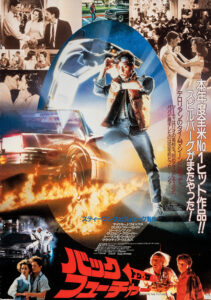 As far as the rest of the movie goes, I’ve always loved the way that the picture weaves a complicated and yet not-all-that confusing story that spans pasts, presents, and futures with great ILM special effects, particularly innovative for their time. It’s a rollercoaster ride that ends leading right into the next installment, very much like an amusement park attraction you can’t wait to take another turn on.
The one universal criticism that was leveled at the movie — that it lacked the warmth and heart of its predecessor– is more than compensated for in BACK TO THE FUTURE PART III (119 mins., 1990, PG), which abandons the technical wizardry and time-traveling element of the second picture and concentrates on telling a central story – marked by a charming romance between Doc Brown and an 1885 Hill Valley woman (Mary Steenburgen) – set in the Old West.
Or, to be more precise, in the Old West of Hollywood’s Golden Age. A handful of character actor veterans pop up in this fitting end to the trilogy, which focuses on Marty trying to get back to his present while Doc falls in love and has to contend with Biff Tannen’s gunslingin’ forefather (Tom Wilson again, in another appropriately nasty performance).
Another rousing score by Alan Silvestri (his finest of the series in fact) rounds out a perfect finale to the franchise, which – along with its predecessors – is contained here in an attractive 4K UHD package. The Dolby Vision, HDR-compatible transfers still look dynamite, saturated with warm colors and HDR usage that brings out the best in Dean Cundey’s cinematography. The Dolby Atmos sound doesn’t offer a whole lot of “Atmos overhead pop” but more gently lends some activity to the expanded sound field while mostly adhering to the original stereophonic sound design (itself still presented in a 5.1 DTS MA mix on the Blu-Ray discs).
In terms of supplements, Universal has produced some new 40th Anniversary extras including “40 Years Later: Reflecting on BTTF,” a new, half-hour interview with Bob Gale; “Back to Hill Valley” with Donald Fullilove (“Goldie Wilson”) and Gale revisiting filming locations; “Untold Stories of ‘Back to the Future,’” which is a fuller 47-minute cast/crew retrospective, also newly produced for this release; a 15-minute TCM Classic Film Festival panel with Gale and Dean Cundey; and a brief Gibson guitar featurette that offers Michael J. Fox.
 The bonus disc from the 2020 UHD package is also here, highlighted by four minutes of outtakes featuring a smattering of audition reels – from Billy Zane testing as Biff to Kyra Segdwick as Jennifer and Ben Stiller as Marty – plus two demo songs, and a featurette, on the “Back to the Future Musical.” There’s also a segment on the Hollywood Museum’s BBTF exhibit and a 20-minute “Can You Survive The Movies” online episode on how realistic some of the film’s science actually is (not much, unsurprisingly).
Also included on the bonus disc are goodies from the 30th Anniversary (2015) Blu-Ray release. These include a brief short with Christopher Lloyd in-character, “Doc Brown Saves the World,” plus two episodes from the 1991 animated series, a 2009 retrospective doc, a featurette on the 2012 restoration of the DeLorean, and 2015 “Jaws 19″ and Hoverboard commercials.
More extensive and engaging supplements from the 2010 Blu-Ray are, of course, also reprised here, starting with the 2010 retrospective doc, “Tales From the Future,” a documentary presented on each film platter in multiple parts.
This retrospective offers comments from Zemeckis, Gale, Spielberg, and all the stars; even Claudia Wells, who notably hadn’t been interviewed on-camera about her role as Jennifer in the original BTTF, appears (and looks great too) and divulges how she left the business at the time of the sequels’ shooting to focus on her family. While some of the anecdotes have been heard before in other featurettes, this doc marked the first time viewers were able to see actual footage from Eric Stoltz’s five weeks of shooting as Marty McFly. The Stoltz footage is extremely brief and we never so much as hear him utter a word (are they still trying to keep his performance a secret?), but it’s still jarring to see him in Fox’s shoes. Even in these brief moments something seems just, well, “off” about Stoltz in the part, since other than bearing more of a physical resemblance to Crispin Glover than Fox, one can’t imagine he would’ve been able to fill the needed comedic demands of the role (and apparently, according to Zemeckis, he didn’t). There’s also a brief look at Silvestri’s score on the first “Back to the Future” disc, though the composer himself only appears in archival interview segments.
The other big feature in those extras was the inclusion of footage from “Back to the Future: The Ride,” the terrific, but now sadly defunct, Universal Studios amusement park ride which opened in 1993 and closed in the Hollywood and Orlando locales in 2007. The 30 minutes of footage (culled from a videotape master) on-hand here includes all the pre-show material and the ride itself, with Christopher Lloyd and Tom Wilson reprising their roles as Doc and Biff.
Plenty of supplements have also been carried over from the DVD edition that were later enhanced for the prior Blu-Ray. Among the latter are the deleted scenes and outtakes from the trilogy; plus music videos, archival promotional material, DVD documentaries and previously-released commentary tracks.
Among the latter is a live Q&A session commentary – conducted for the DVD release – with Zemeckis and Gale that was recorded at USC under the guidance of home video specialist Laurent Bouzereau. The track runs anywhere between 60-90 minutes each on all three films, with the two filmmakers fielding questions read by Bouzereau from students. The two cover the bases from the (mis)casting of Eric Stoltz in the original version of BTTF, to the infamous “To Be Continued” line that was added to the video release of the first movie. Along the way, the two talk about Fox’s crazed schedule, Spielberg’s involvement in the films, and – most tellingly – Crispin Glover’s insane demands that lead to his ouster from II and III (and how the sequels had to be rewritten to cover for his absence – probably, collectively, their biggest drawback). There are some revealing moments in this track, but getting to the tastier nuggets does, admittedly, take a while.
There’s also a secondary commentary track on the trilogy with Bob Gale and producer Neil Canton which is more interesting but, unfortunately, also pretty dry. More than a few times Gale brings up topics but refuses to go into them, claiming that they were already covered in other supplements.
A digital copy and Blu-Ray discs round out the package, making for the latest and greatest edition of “Back to the Future” to be presented yet on home video – though one wonders what will be cooked up in proper time for the 50th!
NEXT TIME: Warner Archive new releases! Until then, don’t forget to drop in on the official Aisle Seat Message Boards and direct any emails to our email address. Cheers everyone!