Some of the first R-rated movies I ever watched were Cannon’s “Ninja” films, which my friend Ryan had rented from Video Plus (Greenville, Rhode Island’s video mecca at the time) several times after school finished in our late elementary years. Available for the first time on 4K UHD and in a nifty collector’s box at that is THE NINJA TRILOGY (Kino Lorber), which kicked off in grand style – for action fans – with the 1981 quasi-classic ENTER THE NINJA (99 mins., R).

Version 1.0.0
Directed by Cannon mogul Menahem Golan himself, this one offers the great Sho Kosugi – but only in a supporting role, playing opposite the westerner who infiltrates the ways of the secretive, mysterious ninja. That man here is Franco Nero, whose martial arts expertise comes in handy when he engages with slick (in more ways than one) oil men, who end up hiring ninja-for-hire Kosugi as a worthy opponent.
There’s a load of entertainment in “Enter the Ninja,” which offers solid production values for Cannon along with Susan and Christopher George in support. “In Search Of…” vets W. Michael Lewis and Laurin Rinder scored the movie, which boasts plenty of decently executed action scenes and a bit of a sense of humor. It also helps that Nero seems more energetic here than usual – and admittedly, there’s a lot more fun to be had here than “The Salamander”!
Kino Lorber released “Enter The Ninja” on Blu-Ray a few years back but their new 4K UHD (1.85) is a major improvement as it sports a fresh 4K scan of the 35mm OCN, offering clear advantages in color, detail and contrasts over the old MGM master. A new 5.1 remix is included (as it is for all three films) plus the 2.0 original audio, the trailer, and the previously released commentary track from action movie specialists Mike Leeder and Arne Venema.
 The second entry in Cannon’s Ninja trilogy, REVENGE OF THE NINJA Blu-Ray (90 mins., 1983, R), offered Sho Kosugi the lead role of a skilled fighter and family man who flees to the United States to get the remainder of his family away from goons who, of course, proceed to torment him and his son even after he ends up in the U.S.
Director Sam Firstenberg dispenses with the bloated pace of Menahem Golan’s original and serves up a briskly-told B-movie favorite that ranks with the best of Cannon’s offerings along similar lines. Kino Lorber’s UHD (1.85, 5.1/2.0) again one-ups the ancient MGM HD master with a solid layer of film grain and warmer colors on-hand. Extras include commentaries by Mike Leeder and Arne Venema, plus Firstenberg and stunt coordinator Steven Lambert. There’s also a vintage intro from the director, a photo gallery and the trailer.
Rounding out the trilogy is NINJA III: THE DOMINATION (92 mins., 1984, R), which doesn’t require a viewing of its predecessors to fully appreciate. In fact, this third and final series entry remains one of my favorite Cannon films for its mix of genres and downright goofiness.
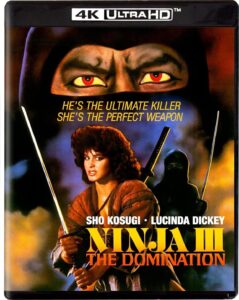 The lovely Lucinda Dickey (star of the studio’s “Breakin” pics) plays an aerobics instructor who becomes possessed by an evil ninja and sets out to seek revenge on his killers. Meanwhile, “good” ninja Sho Kosugi attempts to help Lucinda overcome her increasingly unhinged ways in a wild and woolly good time from director Sam Firstenberg and writer James R. Silke.
“Ninja III” offers all the best elements of a typical Cannon film: well-executed action scenes, a ridiculous plot, a good-looking female lead and some unintentional humor livening up the mix of genres that are uniquely exclusive to “The Domination.” This is silly, unadulterated ‘80s entertainment all the way, and Kino Lorber’s 4K UHD (1.85) one-ups both previous Shout Blu-Ray releases in terms of its overall composition and colors thanks to its 4K remaster of the 35mm OCN, once again with a new 5.1 remix leading the audio side – solidly backing an orchestral/synth hybrid score credited to Misha Segal and Udi Harpaz.
Extras are culled from the Shout releases, including a commentary track with Firstenberg and stunt coordinator Steve Lambert; a 20-minute talk with Dickey which covers her work with Cannon (and eventual dropping out of the “Allan Quatermain” heroine role, which eventually was filled by Sharon Stone), plus interviews with co-star Jordan Bennett, stuntman Alan Amiel, and audio interviews with production designer Elliot Ellentuck and composer Misha Segal, with isolated score tracks thrown in for good measure.
“Ninja III: The Domination” has a lot of nostalgic value for me, as it likely will for those who fondly recall the type of fast-paced B-movies Cannon routinely produced back in the ‘80s. It’s also one of Golan-Globus’ more engaging concoctions, even minus the huge production budget of “Lifeforce” – check it out!
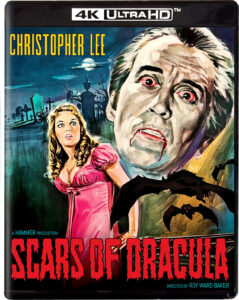 SCARS OF DRACULA 4K UHD/Blu-Ray (95 mins., 1970, R; Kino Lorber): Debuting on 4K UHD for the first time from Kino Lorber is Hammer’s last “period” Dracula installment, one which Christopher Lee apparently hated (at least The Count talks here!) but has still carried a favorable rep amongst some Hammer fans for its nasty (compared to previous Hammer Draculas) sex and violence. It’s not nearly as good as its predecessor – “Taste the Blood of Dracula” – yet Roy Ward Baker’s film retains a certain potency considering the well-worn formula, which would be moved to contemporary times for Hammer’s final two sequels.
This new 4K scan of the 35mm OCN (1.66) results in a really nice looking Dolby Vision HDR transfer, with some splashes of color being much more evident here than previous transfers of the movie. As Tim Lucas notes in his new commentary, it’s almost certainly livelier than the reportedly drab-looking theatrical prints that went out in the U.S. originally, and Lucas’ track – an exclusive to Kino Lorber’s UHD/Blu-Ray – is another hugely insightful, fascinating listen that enriches one’s appreciation of the picture and its placement in the Hammer series.
Legacy extras, in addition to a copy of the Blu-Ray, are ported over from previous releases, including an archival commentary with Christopher Lee and Roy Ward Baker; the trailer; and “Blood Rites: Inside Scars of Dracula” documentary.
 Also New From Kino Lorber
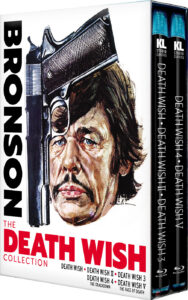
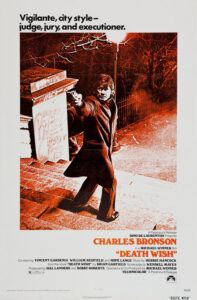
THE DEATH WISH COLLECTION Blu-Ray (Kino Lorber): Available in a definitive box-set for the first time in the U.S. on Blu-Ray is the entire Charles Bronson “Death Wish” collection, sporting Kino Lorber’s previous Blu-Ray releases of four series installments plus their new release of “Death Wish II” (previously on Blu-Ray and UHD from Vinegar Syndrome).
Having recently celebrated its 50th anniversary, the original DEATH WISH (93 mins., 1974, R) became a box-office smash back in the summer of ‘74 and generated one of the most popular roles for its 50-year-old star Charles Bronson, who exclusively shot movies only for Cannon – including a handful of cult-fave “Death Wish” sequels – late in his career.
After his wife and daughter are brutally stalked and attacked returning to their New York City apartment, architect – and conscientious objector – Paul Kersey dashes to a local hospital, only to find out his wife is dead and his daughter psychologically scarred from the trauma. The police have no leads, and Kersey stands by idly one night after the attack watching a gang trash a car in his upper Manhattan neighborhood. No longer wanting to stand pat, Kersey is compelled to take up firearms after flying out to Arizona for a new job, and comes to embrace a lifestyle of vigilantism – removing the societal trash from the streets of a New York City at the height of ‘70s urban decay.
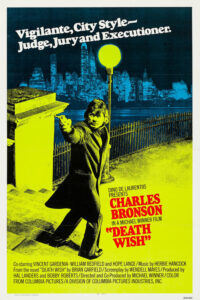 The original “Death Wish” – a Dino DeLaurentiis production – is quite a bit removed from the entertaining, if decidedly more outlandish, Cannon sequels that belatedly followed in the ‘80s. Director Michael Winner, shooting one of his many pictures with Bronson, knows he’s making an exploitation piece but the film has a measured script by Wendell Mayes, who adapted Brian Garfield’s novel after director Sidney Lumet bowed out (Lumet was supposed to direct the picture with Jack Lemmon starring as Kersey – what a different movie that would’ve been!). Bronson’s effective, cool performance anchors the film as Kersey believably makes the transition from urban liberal to gun-trotting purveyor of justice, though there’s no question which side of the fence the movie comes down on in terms of justifying Kersey’s actions. It’s also interesting to see the film’s debate over the use of guns, which is just as timely today, as is the issue of self-defense – and self-preservation – given the rise in crime in major cities like New York over the last couple of years.
Authentically shot on location, the movie makes a perfect companion piece with “The Taking of Pelham 1-2-3″ in terms of showing the Big Apple at the height of the city’s grimy, violent ‘70s trappings. Authentic atmosphere permeates the picture, while familiar faces abound in supporting roles: Jeff Goldblum is one of the thugs who violently attacks Kersey’s family, and the supermarket clerk he quickly bats his eyes at is Sonya Manzano, best known as Maria on “Sesame Street.” An almost unrecognizable Denzel Washington and Laurence Hilton-Jacobs (“Welcome Back, Kotter”) briefly appear as thugs, while Christopher Guest and Olympia Dukakis have early roles as a pair of cops working with detective Vincent Gardenia, who’s terrific in the movie’s second half.
Ultimately, the original “Death Wish” doesn’t have the gleeful, almost comic-book like fun of the later Cannon sequels (the ridiculous “Death Wish 3″ is a personal guilty pleasure that only seems to get better with age), but it’s nevertheless an effective, nasty little picture that captures a time and place – and its corresponding cultural mood – memorably.
 Kino Lorber’s 4K restoration of “Death Wish” (1.85) sports a fresher presentation than Paramount’s own Blu-Ray from 2014, with the original mono sound here joined by a new 5.1 DTS MA mix (I preferred the mono myself). An interview with actor John Herzfeld is included here along with a welcome commentary from Paul Talbot, the Charles Bronson authority who recorded commentaries for other films in the franchise previously.
With the series stretched out over some 20 years, it’s interesting to chart its transition, where the “realistic” first film, released in ‘74, was followed belatedly by a somber 1982 sequel that was marred by a graphic rape sequence. In fact, once Cannon Group moguls Menahem Golan and Yoram Globus got their hands on the property, it was no shock that the sequel machine would soon be cranked up to maximum with Bronson returning to his original role of Paul Kersey first in DEATH WISH II (91 mins., 1982, R) and then several more times throughout the ‘80s.
Michael Winner also returned for the second installment – a rather dreary affair – which Kino Lorber here brings to Blu-Ray (1.85) in two versions: its R-rated theatrical cut plus the unrated version with even more of the movie’s rape sequence restored. Paul Talbot’s commentary has been ported over from previous releases while a new commentary by Steve Mitchell and Nathaniel Thompson has been added.
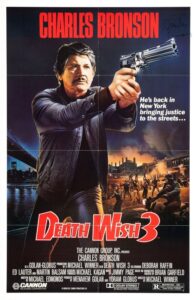
The “fun factor” in the second picture is extremely low – something that would soon be rectified by Bronson and Winner’s follow-up effort. In fact, Paul Kersey takes his street clean-up back to his native New York City in DEATH WISH 3 (91 mins., 1985, R; Kino Lorber), not just Bronson’s best Cannon film but also one of the most deliriously entertaining action flicks of the decade.
 With Sylvester Stallone having taken “Rambo” to box-office heights and other stars like Arnold Schwarzenegger and Chuck Norris packing theaters, Golan-Globus decided to make Kersey more of a one-man wrecking crew this time around, which enables this bigger-is-better follow-up to offer a higher body count and nearly comic-book styled action as Kersey is lured back into town at the behest of an old war buddy who wants protection for him and his neighbors (including Martin Balsam) from the local gangs.
The “Death Wish” formula had already been well established by now but with Cannon bringing the production over to London, the action manages to be wilder and far less disciplined this time out under Winner, who infuses the material with a degree of hysteria and even a few one-liners he scripted alongside Don Jakoby (the movie lists the pseudonym “Michael Edmonds” for its final screenplay credit). The supporting cast offers Ed Lauter, Deborah Raffin, Gavan O’Herilhy (“Superman III”), future Star Trek TNG star Marina Sirtis, and Alex “Bill & Ted” Winter among its familiar faces, while like the second picture, it’s scored in groovy rock fashion by rocker Jimmy Page (arranged and conducted here by “Time Bandits”’ Mike Moran).
With its lean running time and broadly played gunfights and urban skirmishes, “Death Wish 3” is pretty much the apex of Bronson’s ‘80s output as well as the high point for Cannon action movies of that era as well. With nowhere to head but near self-parody, Michael Winner goes for broke here with a tone that’s sillier and far less believable than its predecessors, but in so doing, creates a more entertaining film that showed the veteran star could hold his own with the likes of his younger contemporaries – at least for one final go-round.
 A sequel that’s become an understandable cult favorite over time, “Death Wish 3” sports a new 4K scan (1.85) of the 35mm OCN courtesy of Kino Lorber. The mono soundtrack is just fine while a new 5.1 track has been added alongside an enjoyably chatty commentary by Steve Mitchell and Nathaniel Thompson. A brief interview with actor Kirk “The Giggler” Taylor has been carried over from the Scorpion release plus Paul Talbot’s sage commentary, the original trailer (which credits Jakoby), and an alternate ending tag. Highly recommended!
The set is capped by a reprisal of Kino’s releases of DEATH WISH 4: THE CRACKDOWN (99 mins., 1987, R) and DEATH WISH V: THE FACE OF DEATH Blu-Ray (95 mins., 1994, R).
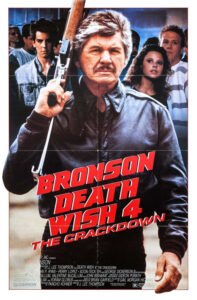
These concluding adventures of former NYC architect-turned-vigilante Paul Kersey are reasonably entertaining if expectations are kept in check. Certainly that’s more the case with DEATH WISH 4: THE CRACKDOWN, which had a tough act following up the deliriously entertaining, Rambo-esque insanity of the third picture. Michael Winner had filmed the first three “Death Wish” outings but dropped out of this fourth entry, being replaced by Bronson cohort J. Lee Thompson. The result finds Bronson’s Kersey being employed by a mysterious benefactor (John P. Ryan) to rid L.A. of drug traffickers – this after the daughter (Dana Barron) of his new girlfriend (Kay Lenz) fatally overdoses on crack.
There’s more topicality in Gail Morgan Hickman’s script than you might expect, and the film benefits from a slight adjustment in formula – even if it opens with a tasteless (fantasy) rape sequence seemingly thrown in “just because.” There are also some seriously rough supporting performances in Soon-Teck Oh and George Dickerson’s respective portrayals of L.A. detectives, not to mention at least one hilarious puppet death shot. On the downside, Thompson’s pacing is slack and the continuously brutal assault on female characters may prove grating, with a particularly harsh and unnecessary fate for Lenz’s character leaving one with a sour taste.
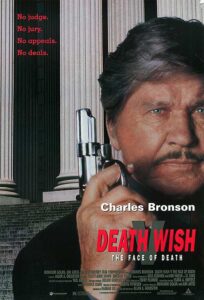
 The Cannon Group dissolved as we knew it by the early ‘90s, with producer Menahem Golan heading off to found his own “21st Century Film Corporation.” One of the few theatrical releases Golan’s post-Cannon studio turned out was DEATH WISH V: THE FACE OF DEATH, which went out nationally through Trimark Pictures in the January ‘94 box-office dumping grounds minus its numerical designation.
This finale to the series was filmed in Toronto by a mostly Canadian crew and looks more like a TV movie than Cannon’s previous sequels. Indeed, this low-budget affair was shot so quickly it was in theaters within a couple of months of principal photography concluding – and it looks it. With Gail Morgan Hickman’s proposed premise of Kersey taking on terrorists in Alcatraz being tossed due to budgetary concerns, director Allan A. Goldstein (who replaced Steve Carver after the production relocated to Canada) instead serves up a recycled storyline wherein NYC goons claim the life of Bronson’s newest sacrificial lamb (Lesley-Anne Down).
That said, the story is reasonably competent even with the limited visual trappings and Saul Rubinek does his usual thing as Kersey’s sympathetic D.A. friend. Bronson seems a little less engaged by the limited action, as if he was just wandering in from his trailer and delivered his lines as efficiently as possible, but if you’ve made it through the first four films you might as well complete the experience.
“Death Wish V” offers a serviceable Lionsgate master (1.85, 2.0 stereo) while “Death Wish 4” appears to be the same MGM master (1.85, mono) which was previously released on Blu-Ray via MGM. Both discs include trailers and informative commentaries by (who else) Paul Talbot.

Version 1.0.0
Also New on 4K UHD
BOOGIE NIGHTS 4K UHD (155 mins., 1997, R; Warner): Wildly overpraised by a number of critics, Paul Thomas Anderson’s very Martin Scorsese-esque take on the blooming late ’70s porn industry and its subsequent fall in the early ’80s is an overlong, at times grossly underwritten, though undeniably stylish and generally well-performed film.
In one of his breakout acting roles, Mark Wahlberg plays a talentless dweeb whose physical attributes below the belt enable him to become a prime picking for porn filmmaker Burt Reynolds, who brings Wahlberg into his extended family of drug addicts, high school dropouts, and other assorted lowlifes–not the least of which include deadbeat mom Julianne Moore and the forever rollerskating Heather Graham.
From the bloated running time to its under-developed characters, it’s clear that writer-director Anderson needed more than a few film-school classes and all-too apparent viewings of Gdoofellas” to put this one across. “Boogie Nights” is bathed in the era’s style by cinematographer Robert Elswit but is filled with endless tracking shots right out of the Scorsese playbook, yet it’s astonishing how little character development there is for a movie that goes on for over two and a half hours.
For example, when Anderson wants us to (apparently) feel sympathy for Moore at a meeting with her ex-husband at the end of the film, it’s a feeling we completely cannot share since we’ve been deluged with two hours of seeing Moore and others getting wasted, fooling around, and generally acting as if their brains were already toasted beyond all measure. You can’t have it both ways, which is a sentiment even more clearly defined by the picture’s ending, where Anderson tacks on a “happy epilogue” of sorts that contradicts the entire downward spiral that came before it.
A plastic movie with plastic people and ambitious intentions, “Boogie Nights” nevertheless ushered in Anderson as a new cinematic voice as the ‘90s rolled on, and Warner’s 4K UHD (2.35) offers up a brand new HDR10 grading of the film that, if nothing else, enhances the previous, older Blu-Ray the studio released. 5.1 DTS MA sound is on-tap while extras include an American Cinematheque Q&A with Anderson and John C. Reilly, two commentaries, additional scenes and other extras from the original New Line DVD.
 CLOUD ATLAS 4K UHD (171 mins., 2013, R; Shout!): It’s never a good sign that my first response after starting “Cloud Atlas” for the first time – and upon hearing Tom Hanks’ garbled dialogue – was to double-check the disc menu to ensure it was set on English.
This expensive box-office bust from the Wachowski siblings and German filmmaker Tom Tykwer is an almost indecipherable mess of multiple timeframes, characters with shared, “connective emotional experiences,” actors playing multiple roles (including, in a few instances, different genders and ethnicities) and assorted tragedies that run from the gamut from the 1800s through England in the ‘30s; early ‘70s San Francisco; present-day London; a futuristic Korea; and a post-apocalyptic (or whatever) world that finds Hanks running around in a forest, looking nearly as lost as Kevin Costner did in “Robin Hood: Prince of Thieves.”
It takes all of 10 minutes for you to realize that there’s something truly “off” with “Cloud Atlas.” Why is Hugh Grant speaking with an American accent and a truly horrible nasal prosthetic? Why is Susan Sarandon also saddled with a laugh-inducing nasal prosthetic? Why does Tom Hanks’ gangster British author feel as if he’s been dropped in from a terrible Saturday Night Live sketch? Why is Hugo Weaving dressed up like a refugee from a Tim Burton film? What do the bombastic futuristic sequences – handled by the Wachowskis – have to do with Twyker’s ‘30s set tale of a young gay man killing himself after Jim Broadbent steals his classical music composition?
The answers are supposedly buried somewhere in the rubble of this near three-hour dud (basically they amount to Mitchell’s new-age reincarnation theory and assertion that we’re all “connected”), which would’ve been good for a few laughs – or the interest of bad movie buffs – if it weren’t for its unmanageable running time. To its credit, John Toll and Frank Griebe’s cinematography is stellar, with colors and textures flying off the screen, but the film is so muddled and silly that only devotees of David Mitchell’s book are likely to tolerate – much less understand – it.
Shout’s 4K UHD of “Cloud Atlas” at least looks spectacular with Dolby Vision HDR (2.39) via a 4K scan of the Digital Intermediate that really enables you to savor the film’s technical achievements. Tykwer, Johnny Klimek and Reinhold Heil’s musical score is one of the film’s strongest assets (admittedly, it doesn’t take much). There’s also a substantial, brand-new feature-length documentary, “What is an Ocean,” which includes brand-new interviews with Hanks, the Wachowskis, Tykwer, and many others.
 Box Set Round-Up
BLAXPLOITATION CLASSICS Volume 2 4K UHD/Blu-Ray (Shout! Factory): WHAT IT IS: In addition to releasing loads of classic Hong Kong martial arts/kung-fu fare, Shout! rolled out a pair of Blaxploitation Classics box-sets on 4K UHD this past year, with the second volume offering genre buffs a number of fan-favorite affairs. Pam Grier and Jim Brown are the main beneficiaries of the deluxe treatment afforded to these AIP outings, collected by Shout via 4K MGM remasters that boast Dolby Vision HDR and clear mono sound across the board. Included here are BUCKTOWN (94 mins., 1975, R) starring Grier and Fred Williamson; FRIDAY FOSTER (90 mins., 1975, R), with Grier as the comic strip photojournalist whose friend is murdered after she witnesses the assassination of a black politician; FOXY BROWN (92 mins., 1974, R) with Grier again in the title role of a woman seeking justice for her slain boyfriend; Jim Brown in both SLAUGHTER (92 mins., 1972, R) and SLAUGHTER’S BIG RIP-OFF (94 mins., 1973, R), the latter co-starring Ed McMahon!; and the terrific COTTON COMES TO HARLEM (97 mins., 1970, R), an adaptation of Chester Himes’ novel with Godfrey Cambridge and Raymond St. Jacques. TECH SPECS: On the UHD end, new 4K scans from each film’s respective OCN with Dolby Vision HDR (1.85 except for 2.35 on the “Slaughter” films) and mono sound comprise terrific UHDs. Blu-Rays are also included, with featured extras highlighted by Part Two of Shout’s look at AIP Blaxploitation films, “Cost to Be the Boss,” plus assorted extras on the “Foxy Brown” disc (interviews, commentary by director Jack Hill). AISLE SEAT BOTTOM LINE: “Blaxploitation Classics” Vol. 2 packs plenty of entertainment for genre fans with top-notch transfers across the board. Strongly recommended!
Version 1.0.0
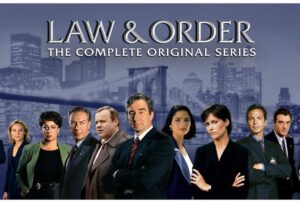
LAW AND ORDER – The Complete Original Series DVD (20718 mins., 1990-2010; Universal). WHAT IT IS: Dick Wolf’s NBC series helped define the modern crime procedural on network television, providing mostly self-contained cases with a simple formula: a first half featuring NYPD detectives working a crime, then a shift in focus following the lawyers charged with prosecuting the perp(s) in the series’ second half-hour. The mix worked even with its cast coming and going over the years – with my favorite ensemble featuring Paul Sorvino and Chris Noth in its opening portion with the unpredictable rhythms of Michael Moriarty and Jill Hennessy serving its back-half as well as any. Eventually, the stars would be replaced by capable performers like Jerry Orbach and Sam Waterston, but the format held for the most part, resulting in ratings magic and endless spinoffs, some of which eventually eclipsed the “mothership” in terms of popularity. Ultimately, NBC ended the original series in 2010 before bringing it back in 2021 – but that initial run from 1990-2010 is collected here in a “Complete Original Series” DVD box featuring the first 20 seasons of “Law & Order.” TECH SPECS: Universal’s DVDs feature 4:3 transfers/2.0 audio for its earlier years before the transition to 16:9/5.1. AISLE SEAT BOTTOM LINE: The only downside to Universal’s box is the standard-def DVD format usage here – Blu-Ray would’ve been preferred – yet the transfers and encoding are still decent in this mammoth set preserving a bona-fide TV classic.
 Quick Takes
A BIG BOLD BEAUTIFUL JOURNEY Blu-Ray (109 mins., 2025, R; Sony): In the boom-or-bust box-office marketplace of 2025, there are usually clear-cut winners and losers, and this well-acted if inconsequential romantic drama failed to find an audience. Star-crossed lovers Margot Robbie and Colin Farrell meet at a friend’s wedding and then relive good and bad moments from their respective pasts in Seth Ross’ original script, dressed up with Kogonada’s direction which adds style to a pleasant if hum-drum vehicle co-starring Kevin Kline. Sony’s Blu-Ray (2:1, 5.1 DTS MA) includes two fetaturettes, a musical number, and Digital HD code.
BOGONIA 4K UHD/Blu-Ray (119 mins., 2025, R; Universal): Yorgos Lanthimos’ eclectic output seems perpetually designed to placate a certain cinematic niche, and “Bogonia” – a remake of a South Korean film – is no different. Lanthimos once again provides a showcase for Emma Stone, here playing a CEO kidnapped by insane (or is he) Jesse Plemons and his autistic cousin (Aidan Delbis), who believe she’s really part of an alien species bent on destroying the planet. Stone goes for broke, shaving her head in the process, but ultimately this is yet another dour, depressing outing from the director pretty much playing along the same lines as its foreign predecessor. Universal’s 4K UHD (1.90) boasts Dolby Vision HDR, Dolby Atmos sound, a Making Of, Blu-Ray and Digital HD code.
Version 1.0.0
GOOD FORTUNE Blu-Ray (97 mins., 2025, R; Lionsgate): Comic Aziz Ansari’s first finished feature directorial outing (following a movie where star Bill Murray acted up, causing the production to stop midway through principal photography) features Ansari as a struggling L.A. gig worker, Keanu Reeves as a hapless angel, and Seth Rogen as a successful entrepreneur who Reeves switches Ansari’s place with. The net result is a comedic fable with some amusing moments but not enough dramatic heft keeping the picture, and Ansari’s original script, float; Lionsgate’s now-available Blu-Ray (1.85, Atmos) offers commentary by Ansari and producer Alan Yang, a couple of featurettes, and a Digital HD code.
HAZBIN HOTEL Season 1 Blu-Ray (184 mins., 2025; A24): Vivienne Medrano’s original animated series – for adults – chronicles the adventures of the “Princess of Hell,” aka Charlie, who seeks to rehabilitate demons by reducing her kingdom’s overpopulation of them. Amusing songs and raunchy humor abound in “Hazbin Hotel,” an Amazon series new on Blu-Ray from A24 featuring 1.78 transfers, 5.1 audio and loads of extras, including episode commentaries and an exclusive foil or cracked ice promo card for “Hazbin Hotel Trading Cards.”
NEXT TIME: 2026 kicks off with SNAKES ON A PLANE and UNDER SIEGE in 4K! Until then, don’t forget to drop in on the official Aisle Seat Message Boards and direct any emails to our email address. Cheers everyone and Merry Christmas to all!