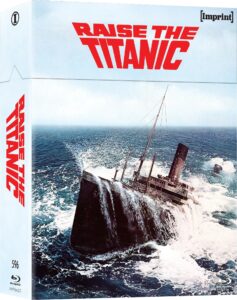
Sir Lew Grade’s ITC Entertainment produced a number of high-profile cinematic vehicles in the ‘70s, many of them ending up as notable box-office failures. The most notorious of the lot was RAISE THE TITANIC (116 mins., 1980, PG), a film that’s actually not nearly as terrible as its disastrous commercial performance would lead one to believe, and which has been re-issued in a new, 2-disc Blu-Ray limited edition from Via Vision’s Imprint label.
 In order to tap into the film’s mindset, one has to travel back to the late ‘70s and early ‘80s – before Robert Ballard discovered the wreck of the ill-fated White Star liner and James Cameron spearheaded numerous expeditions down to the bottom of the Atlantic during and after the production of his 1997 blockbuster.
In fact, one of the more memorable moments during my family’s sailing sojourns around southern New England and the islands (Martha’s Vineyard, Nantucket, Block Island) in the ‘80s was when my cousin – a marine enthusiast – picked up a radio transmission one summer day from Ballard’s crew, communicating that they had “found something.” While it wasn’t expressly spelled out, my cousin deduced that they had found the Titanic – something confirmed in newspaper and TV reports over the subsequent days, back in the pre-internet era when news traveled just a little bit slower than it does now. For a couple of days, at least, we were in on the scoop, and soon Titanic fever would again captivate the general public around the world.
Clive Cussler’s book “Raise the Titanic” was published nearly a decade prior to Ballard’s discovery. At the time, a notion like discovering the wreck and raising it – even if it was still a flight of fancy in Cussler’s novel – wasn’t totally out of the realm of believability, since the author wasn’t aware that the vessel had broken into two parts on the way down to its watery tomb. One of several books starring Cussler’s hero, Dirk Pitt, the book was a fast read – entertaining and compelling, and an ideal project for a feature film.
Regrettably, despite an ample budget, the ITC-produced “Raise the Titanic” was a huge bomb (Grade ultimately remarked it would’ve been more cost efficient to lower the Atlantic!). The movie certainly has its share of shortcomings – a lack of character development and human engagement, a ponderous mid-section – but it also, as Roger Ebert noted in his original review, “has some wonderful moments,” even if “they’re bogged down in two moronic subplots.”
At least Richard Jordan was a fitting choice for Dirk Pitt, who’s tasked with raising the doomed ship after the U.S. government discovers that the Titanic was carrying a rare element named Byzantium – something that could, decades later, be used to develop a nuclear defense perimeter around the U.S. Pitt, along with old chum Admiral Sandecker (Jason Robards) and Dr. Seagram (David Selby), not only has to find the Titanic and raise it, but also head off an attempt by the Russians to access the Byzantium and claim the ship for themselves.
Stanley Kramer was originally attached to “Raise the Titanic,” and brought in screenwriter Adam Kennedy to rewrite Eric Hughes’ original adaptation of Cussler’s novel. Though Kramer eventually dropped out, the remnants of his involvement (specifically its reworked politics) can be found on the finished film, which was ultimately directed by Jerry Jameson.
Despite its terrible reputation, it’s a movie that’s never awful – it is, at times, tedious, especially during its less-than-thrilling sequences of submersibles descending upon the Titanic and their assorted problems in bringing the ship back to the surface. There’s also a lack of development among the film’s protagonists – the movie moves along in workmanlike fashion without pausing for scenes that could’ve fleshed out the script’s otherwise vacant character motivations. Why is Pitt so constantly irritated with Dr. Seagram? And so what if Pitt’s former flame (a worthless role for the lovely Anne Archer) is currently involved with him? There’s no pay off to their sequences, and no point at all in Archer’s token female character even being involved in the picture to begin with. The movie is more interested in hardware than humanity, and that lack of engagement undoubtedly was the main reason why most viewers found it dull and uninteresting.
If one can overcome the film’s problems, however, and acknowledge the film is a missed opportunity, then there are still some rewards to be found in “Raise the Titanic” – namely, John Barry’s majestic, beautiful score, which carries the film and gives it an otherwise absent emotional undercurrent. The opening montage of archival photos from the White Star liner, set to Barry’s main theme, is wonderfully done, and a brief sequence where Pitt meets one of the surviving crewmen from the vessel (Alec Guinness) carries a poignant resonance that pays off in Pitt raising the flag of the White Star line once the Titanic resurfaces. More moments like those could’ve made “Raise the Titanic” truly special.
The special effects in the movie are also solid for their time, especially the model work (shot in Malta’s tank) and the concluding sequences of the Titanic sailing back into port in New York City, completing its maiden voyage at last. There’s also a haunting shot of the Titanic passing by the twin towers of the World Trade Center – sequences that still move the viewer even with their pre-CGI technical rendering.
“Raise The Titanic” has been released on Blu-Ray from Shout! Factory in the U.S. and Network in the UK, both times in the same master and stereo sound.
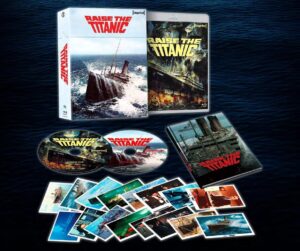 Imprint’s new release hails from the same source materials as those older releases, but the jump in bit-rate and the label’s improved encoding results in something of a modestly appreciable enhancement. Certainly it’s hard to envision any additional improvements ever being made to this older ITC high-def master, which is properly framed and offers adequate detail. There’s no attempt to mask the various optical effects employed on the movie, which is for the best but younger viewers may lack an understanding of why the FX and model work on the picture, while mostly appearing primitive today, were also so effective for their time.
The restoration of the movie’s scope aspect ratio and its stereo sound enhances Barry’s magnificent music across both 5.1 DTS MA and 2.0 PCM stereo tracks; needless to say it’s all superior to the movie’s old pan-and-scan home video and broadcast TV versions, which were so murky even ITC’s personnel apparently advocated for trimming more of the movie’s underwater sequences since they were nearly incomprehensible in standard definition.
A lengthy trailer is included here along with an “alternate scene” of the Titanic being lit (from a standard-definition source) and “test footage” of the discarded 1912 prologue showing the boat’s sinking – sadly this was culled seemingly off an online video with heavy compression and barely lasts a minute (said footage was ultimately used in an episode of NBC’s short-lived sci-fi series “Voyagers!”).
New extras include interviews with assistant editor Geoffrey Mackrill, production manager Frederick Muller and historian Jonathan Smith. There’s also a half-hour, promotional syndicated TV documentary, “The Last Great Human Adventure,” culled off a secondary VHS source, along with behind-the-scenes footage of the Malta tank and model construction, a photo gallery and more, set to Network’s previously released suite of John Barry’s score from damaged (and incomplete) mono music/effects elements. It’s all housed in a glossy hardbound box with a mini-hardcover Making Of book with production information and behind-the-scenes photos.
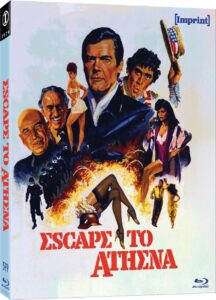 Also new from Imprint this month is a Special Edition of ESCAPE TO ATHENA (118 mins., 1979, PG), one of the last of the “all-star international cast” extravaganzas of the 1960s and 70s to hit theaters post “Star Wars.”
This WWII-set ITC affair offers an intriguing premise, where Allied prisoners, tasked with digging up artifacts for the Nazis, plot their own escape from a scenic Greek island while finding actual treasure. The disparate group includes the likes of Elliott Gould (as “Charlie”), David Niven, Sonny Bono, Stefanie Powers and Richard Roundtree, while Claudia Cardinale plays a madam and Telly Savalas runs the local Greek resistance movement. They’re up against a slew of occupying Nazis including top-billed Roger Moore in a clear change of pace role from his Bond productions of the era.
Another of Lew Grade’s ITC box-office underperformers, this effort from director George P. Cosmatos never finds its center during its initial hour, where the picture’s tone fluctuates from a seemingly light “caper” to a harder-edged war picture. The cast is great but a few of the performances are also overly broad – yet all that said, “Athena” remains fun and finally gets cranking in its second half thanks to a number of lively action set-pieces, all of it accompanied by a terrific Lalo Schifrin score.
A movie which looks like it hails from an earlier part of its decade (I literally believed for years it came out in the early/mid ‘70s, not 1979!), “Escape to Athena” previously generated a U.S. Blu-Ray in a Shout double-feature with Lew Grade’s earlier flop “March or Die.” This Imprint Blu-Ray yet again hails from the same older ITC master but, thanks to its high bit-rate transfer, looks the best of the bunch (the 2.0 PCM mono sound is crisply delivered as well).
A welcome new commentary includes Lee Pfeiffer, Hank Reineke and Paul Scrabo while the TV spot, trailer, and an eight-minute interview with Gould (conducted at the same time as his recent appearance in the extras for “A Bridge Too Far”’s UHD) are also included – as are a full run of engaging if brief interviews shot on the set with all the major stars. These include Elliott Gould talking to the kids of the cast, including his son Jason and Chastity Bono among others.
NEXT TIME: OCN Summer Rundown! Until then, don’t forget to drop in on the official Aisle Seat Message Boards and direct any emails to our email address. Cheers everyone!